Best Aceternity UI alternative.
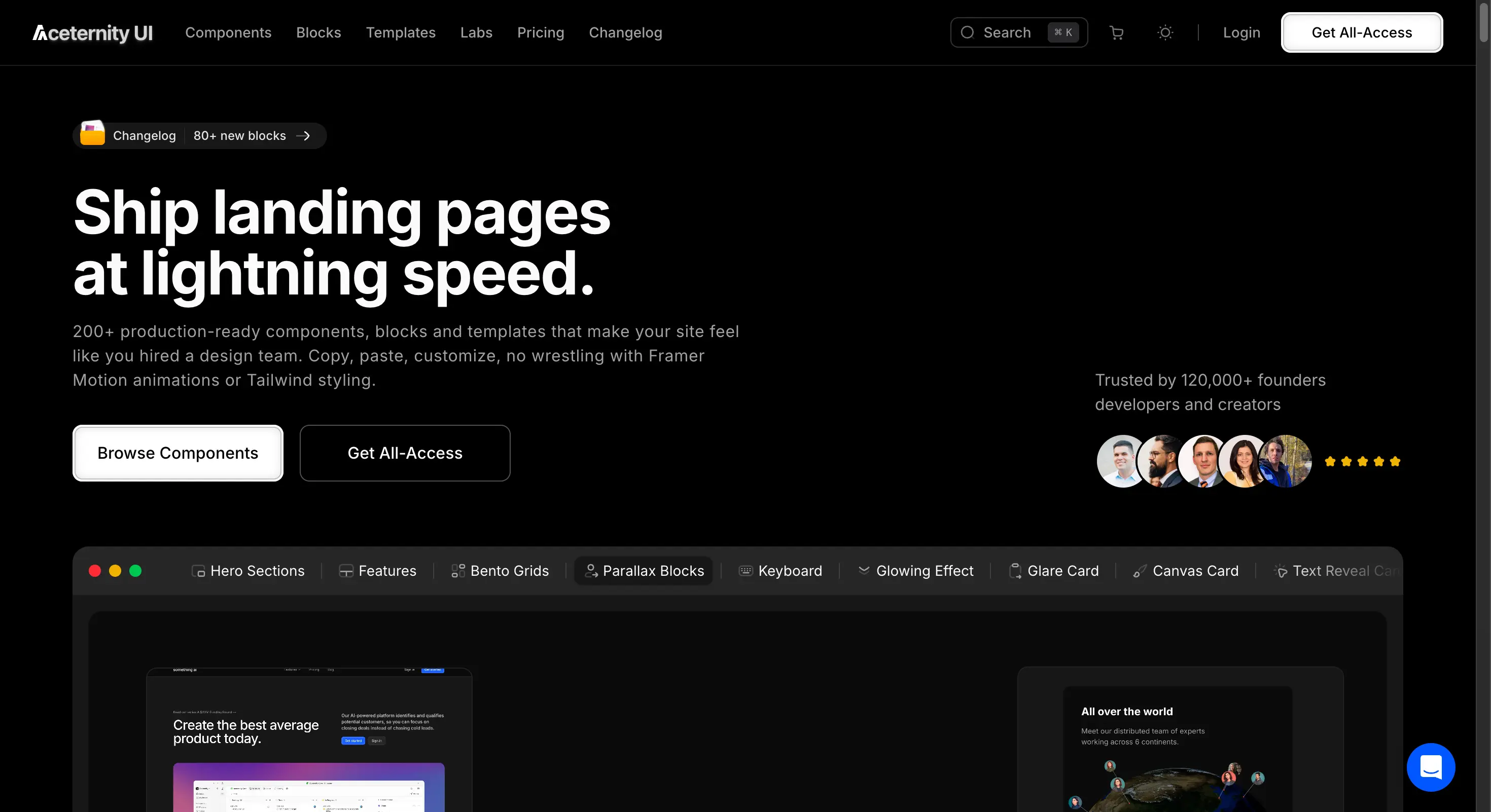
Screenshot of ui.aceternity.com, taken 7 August 2026. Aceternity UI is a separate product and is not connected to Wensity.
If you are searching for an Aceternity UI alternative for React and Tailwind CSS, this guide compares Wensity UI and Aceternity UI in plain English. You will find pricing, tooling, motion quality, and which one suits a real product rather than a single landing page.
What is the best Aceternity UI alternative?
Wensity UI is the best Aceternity UI alternative in 2026. It gives you 161 React components, 92 of them free, including 57 UI building blocks for the everyday parts like forms, tables, and menus. It has its own command line tool, ready made section blocks, and groups built for dashboards and AI screens.
Aceternity UI is very good at what it says on its own homepage: shipping landing pages quickly. Wensity UI is built for the whole product. The look is calmer and more premium, the motion is richer but never noisy, and the components are made to hold up once real data goes into them.
Choose Aceternity UI if you want loud, eye catching effects for a marketing page. Choose Wensity UI if you want a polished product that still feels alive, and you want to build it faster with a proper command line tool.
Aceternity UI vs Wensity UI: quick comparison
Every number below was checked on each company website on 7 August 2026. Prices and counts change often, so please confirm before you buy.
| What you are comparing | Aceternity UI | Wensity UI |
|---|---|---|
| Free plan | Yes, a large free component set | Yes, 92 components, no card needed |
| Paid price | 199 dollars, one time | 199 dollars one time, or 169 dollars a year |
| Built for | Landing pages and marketing sites | Landing pages plus dashboards and AI screens |
| Look and feel | Bold, loud, effect first | Premium, calm, dark first |
| Forms, tables, menus | Not the focus | 57 UI building blocks |
| Command line tool | Copy and paste led | Own CLI: npx wensity add, blocks, and presets |
| Frameworks | React and Next.js | Next.js, Vite, Remix, Astro, shadcn friendly |
| Theme changes | Edit classes per component | One theme file with CSS variables |
Which one looks more premium?
This section is our opinion, so please read it as one. We think Wensity UI is the more polished library, and here is what that means in practice.
Restraint reads as expensive
Aceternity leans into big statements: spotlights, beams, tilting 3D cards. It works beautifully in a demo. Put four of those effects on one page and the page starts shouting. Wensity uses flat shadows, thin one pixel borders, and low contrast surfaces. The result looks more like paid software and less like a showcase.
Rich motion that still behaves
Calm does not mean still. Wensity components animate a lot, they just animate with shorter distances and faster settling. Nothing scales up or jumps when you hover it. You get the feeling of quality without the page moving under your cursor, which matters far more on a screen someone uses every day than on one they scroll past once.
Ready for real content
Demos always look good with three short words in them. Real products have long names, empty states, loading states, and numbers that keep changing. Wensity components are built and checked against that kind of content, so spacing stays even and text does not get clipped when the data gets messy.
One file changes your whole brand
Wensity reads every colour from one theme file using CSS variables and Tailwind CSS v4. Change that file and the entire library takes your brand colours. You never search and replace class names across sixty components, and your site does not end up looking like every other site using the same library.
Main differences between Aceternity UI and Wensity UI
Four differences actually change your decision. Everything else is detail.
- Landing page versus whole product. Aceternity stops where your marketing page ends. Wensity keeps going into the settings screen, the billing table, and the chat box.
- Loud versus premium. Aceternity is designed to grab attention in three seconds. Wensity is designed to look expensive and stay pleasant after three hours.
- Copy paste versus real tooling. Wensity has its own command line tool that installs components and blocks, and remembers your style settings between installs.
- One framework versus many. Wensity supports Next.js, Vite, Remix, and Astro, and publishes in a shadcn friendly format so it drops into projects you already have.
Aceternity UI pricing vs Wensity UI pricing
The headline price is the same on both sides, so price alone will not decide this. What differs is what the money buys and whether a yearly option exists.
| Plan | Price | What you get |
|---|---|---|
| Aceternity free | 0 dollars | A large free component set you can copy in |
| Aceternity All-Access | 199 dollars once | Premium blocks, templates, and lifetime updates |
| Wensity free | 0 dollars | 92 components, CLI installs, no card or account |
| Wensity Pro Annual | 169 dollars a year | Every premium component while the plan is active |
| Wensity Pro Lifetime | 199 dollars once | Everything forever, including future updates |
| Wensity Teams | Contact us | Company seats, custom builds, and support |
Worth knowing before you pay either company: both libraries copy real files into your project, so a plan ending never breaks your live site. The code is already yours. You only lose the ability to install new things.
Which one helps you ship faster?
Wensity UI, mostly because of the command line tool. Copying and pasting from a website is fine for your first component and slow by your twentieth. A CLI removes the browser tab from the loop.
# Set up once. This writes wensity.json and a small helper file.npx wensity@latest init# Add any component by name. The real file lands in your project.npx wensity@latest add liquid-multimodal-input# Add a whole section block the same way.npx wensity@latest add hero-section-with-radial-glow --type block# Save your brand colours, radius, and fonts once,# then every later add command matches your style automatically.npx wensity@latest init --preset <your-preset-code>
The preset step is the part that saves the most time. Save your brand colours, corner radius, fonts, and icon set once, and every component you install afterwards already matches your design. You are not fixing styles after each install, which is where most of the hidden hours in a component library actually go.
Which has better integrations?
Wensity UI fits into more places. Aceternity UI is aimed squarely at React and Next.js. Wensity works with Next.js using either router, and also with Vite, Remix, and Astro.
It is styled with Tailwind CSS v4 through plain CSS variables, so it sits on top of a setup you probably already have rather than asking for a new one. Components are published in a shadcn friendly format too, which means an existing shadcn project can pull them in without any folder restructuring.
For teams there is one more piece. Wensity supports API tokens, so your build pipeline can fetch component source automatically instead of a person copying files by hand. That matters once more than two people touch the same design system.
What is Aceternity UI good at?
Aceternity earned its popularity, and pretending otherwise would be silly. Three things it genuinely does well:
- Visual impact is unmatched. If you want a hero section that makes people stop scrolling, nothing on this list hits harder.
- The free set is generous. You can build a very good looking marketing page without paying anything at all.
- Speed for launch pages. For a product launch that needs to look impressive by Friday, it is a strong and honest choice.
How do you switch from Aceternity UI to Wensity UI?
There is no migration to plan. Neither library adds a package that your app depends on while it runs, so nothing needs uninstalling. Run the Wensity setup command, add the components you want, and your existing Aceternity files keep working next to them.
Check two things first. Make sure your project is on Tailwind CSS v4, and make sure only one animation library is installed, since two of them makes your site larger for no benefit. Then point both sets of components at the same theme colours so old and new parts match.
Our advice is simple. Keep your marketing page exactly as it is, and use Wensity for the next new screen you build. One screen is enough to tell whether you want to go further, and it costs you nothing to find out.
Who should pick Wensity UI, and who should stay
Pick Wensity UI if
- You are building a product, not just a marketing page.
- You want a premium and calm look rather than a loud one.
- You want a command line tool that remembers your brand style.
- You are on Vite, Remix, or Astro instead of only Next.js.
- You need dashboards, tables, forms, or AI chat screens.
Stay with Aceternity UI if
- Your work is almost entirely landing pages and launch pages.
- Maximum visual drama is the main thing you are buying.
- You already own All-Access and only build marketing sites.
Other Aceternity UI alternatives worth a look
Wensity UI is not the only option. The right pick depends on what drew you to Aceternity in the first place.
- Magic UI. If you liked the animated effects but found Aceternity a little too dramatic, Magic UI is the calmer version of the same idea, and its core library is open source.
- React Bits. If the free components were the main attraction, this has the largest free collection of creative effects of the group, and it is fully open source.
- Motion Primitives. If you only wanted a handful of motion pieces rather than a full library, this is a smaller and more restrained open source set.
- Tailwind Plus. If the animation was never really the point and you want a lot of plain, dependable components, this is the official Tailwind collection. There is no free plan.
We compare each of these on our UI library comparisons page.
Common questions about Aceternity UI alternatives
Short answers to what people ask most before they choose.
Try it before you decide
Every component has a live preview you can click. 92 of them are free right now, with no card and no account needed.
Aceternity UI is owned by its own company and is not connected to Wensity. Prices, licences, and component counts on this page were checked on 7 August 2026 and can change at any time, so please check ui.aceternity.com before you buy. Views on polish and feel are our own. See our other UI library comparisons.